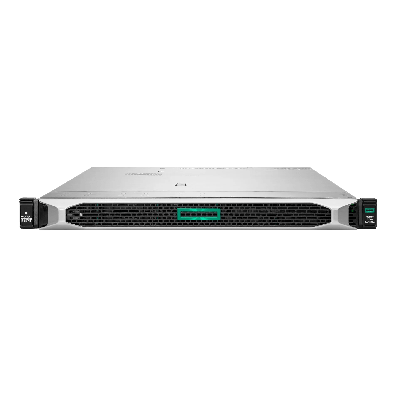
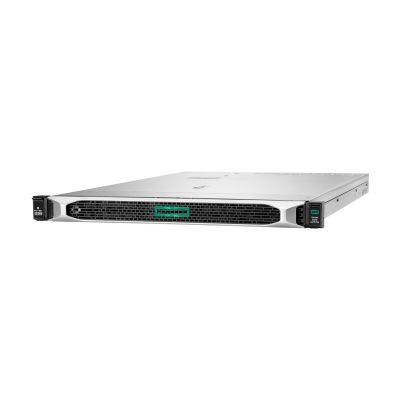
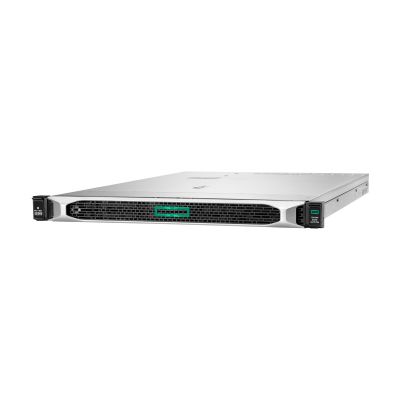
The DL360 Gen10 Plus is HPE's densest general-purpose rack server: two Ice Lake sockets, up to 80 cores and up to 6.0 TB of DDR4 in a single rack unit. It is the machine most people end up with when rack space is the constraint but the workload still needs full dual-socket memory bandwidth. Buying it refurbished puts a Gen4-capable, Optane-ready platform within reach of budgets that would otherwise be looking at single-socket kit.
At a glance
Typical deployments
Virtualisation hosts
Consolidation ratios are limited by RAM long before clock speed becomes an issue. Populate all 16 slots per socket to keep every memory channel balanced, and favour a mid-range 6300 or 5300 part with a high core count over a high-frequency SKU. Two 10GbE or 25GbE ports on the OCP card handle management, vMotion and guest traffic without touching a PCIe slot.
Databases and per-core licensed software
Where the licence is charged per core, fewer and faster cores is the cheaper answer. A high-frequency 6300-series pairing with fully populated DIMMs and NVMe SFF bays gives strong single-thread performance and low storage latency; Optane Persistent Memory is worth considering for large in-memory working sets.
Virtual desktop and session hosts
User density scales with memory and thread count. Two 32- or 40-core processors and a broad DIMM population let you push sessions per host up; the 1U footprint keeps rack and power costs proportional as you add nodes. Check riser configuration if a low-profile accelerator is in scope, as 1U limits card height and power.
Software-defined and hyper-converged storage
The 10 SFF NVMe backplane is the one to specify here — direct PCIe Gen4 paths to the drives, plus enough cores left over for the storage controller software. Pair with 25GbE or faster on the OCP slot, since east-west replication traffic, not the drives, is usually the first bottleneck.
Edge, colocation and branch racks
A single-socket build with the 500W or 800W Titanium supplies keeps draw and heat modest where cooling is shared or metered. iLO 5 does the heavy lifting for sites with no on-hand engineer — full remote console, firmware control and hardware alerting over a dedicated port.
Backup and file services
The 4 LFF chassis trades bay count for capacity per spindle, which suits nearline targets and general file serving. Modest core counts are fine; spend instead on cache-backed RAID and a second power supply, and use the full-height slot for a tape HBA or external SAS connection.
Why buy from Compuwyze
- Every DL360 Gen10 Plus is stripped, cleaned, rebuilt and burn-in tested as a complete system before it is listed, not sold as pulled parts
- Warranty-backed hardware with UK-based technical support from people who work on this platform daily
- Configured to your spec — processor pairing, DIMM population, backplane type, riser and OCP adapter chosen before dispatch
- Genuine HPE components throughout, including SmartMemory and Flex Slot power supplies, so iLO reports clean inventory
- Firmware and iLO brought to a current, consistent level across multi-unit orders for predictable cluster behaviour
- Rails, caddies, bezels and matched spares available so a replacement node arrives ready to rack
Frequently asked questions
What does refurbished mean on these servers?
It means ex-enterprise hardware that has been fully inspected and rebuilt rather than simply wiped and boxed. Chassis are cleaned, fans and power supplies checked, drives and DIMMs tested individually, then the assembled server is run under load and validated through iLO before it goes on sale. Cosmetic marks from rack life are possible; functional shortfalls are not.
Is a Gen10 Plus suitable for production workloads?
Yes. This is a current-generation-adjacent platform with PCIe Gen4, DDR4-3200 and 3rd Gen Xeon Scalable silicon, widely deployed in production clusters today and supported by current hypervisor and OS releases. Refurbished units run the same firmware stack as new ones. For clustered roles we would still suggest matching CPU steppings and memory layout across nodes.
What is included with the server?
Each listing states its exact contents — processors, memory, drives or blanks, controller, riser configuration and number of power supplies. Rails and bezels are listed separately unless the description says otherwise. Data-bearing drives from the previous owner are removed and securely erased or destroyed, so anything supplied is either new or sanitised stock.
Can I add memory or a second processor later?
Both are straightforward. The second socket unlocks its own 16 DIMM slots plus the optional third PCIe slot, and requires the matching heatsink and, in some builds, an additional fan configuration. Memory should be added in balanced sets across channels rather than piecemeal, or you lose bandwidth. Tell us the target configuration and we will supply the parts that fit the chassis you have.
Which drive backplane should I choose?
Pick 8 SFF for a conventional SAS/SATA mix with room for a rear cage or extra cooling, 10 SFF where you want maximum NVMe spindles for latency-sensitive storage, and 4 LFF where raw capacity per drive matters more than IOPS. Backplanes are not casually interchangeable — cabling, controller and sometimes riser choices follow from the decision, so specify it up front.
Does iLO come with an advanced licence?
iLO 5 is embedded on every board and provides health monitoring, power control and remote management out of the box. Features such as full graphical remote console with virtual media are licensed separately by HPE. Ask before ordering and we will confirm what licence state the unit is in so there are no surprises at first boot.